 OpenDissect
All fractures › Ankle & foot
Metatarsal shaft and neck fractures
AO/OTA 87Central and first metatarsals, march fracture
See it in 3D on the real bones, displace and reduce it, with simulated X-ray and CT — free, in your browser.
Open in 3D →The metatarsal heads share the load of the forefoot: the first carries about a third of the forefoot load through its two sesamoids. In the central metatarsals what matters is displacement in the sagittal plane — a head that drops plantarwards becomes a painful callosity, one that rises transfers load to the neighbours. Rotation and shortening are tolerated better. The fifth metatarsal base is a separate entry.
Mechanism
Direct crush (dropped object, run over) usually breaks several adjacent shafts transversely; twisting with a fixed forefoot gives spiral fractures. Repetitive loading (marching, running, a new training load, low bone density) gives stress fractures, typically of the second and third neck or distal shaft — the march fracture.
Clinical findings
- Localised swelling and tenderness along the shaft; pain on axial compression of the toe.
- Crush injuries: skin condition and compartment syndrome of the foot (pain out of proportion, tense dorsum).
- Stress fracture: activity-related forefoot pain over weeks, local swelling; ask about training changes, amenorrhoea and diet (relative energy deficiency).
Imaging
- AP, oblique and lateral of the foot.
- Lateral (or oblique) to judge plantar displacement of the heads.
- Suspected stress fracture with normal films: MRI or repeat X-ray in 2–3 weeks.
- AP, oblique and lateral of the foot. The lateral is needed to judge sagittal (plantar) displacement of the heads, but the bones overlap: an oblique helps.
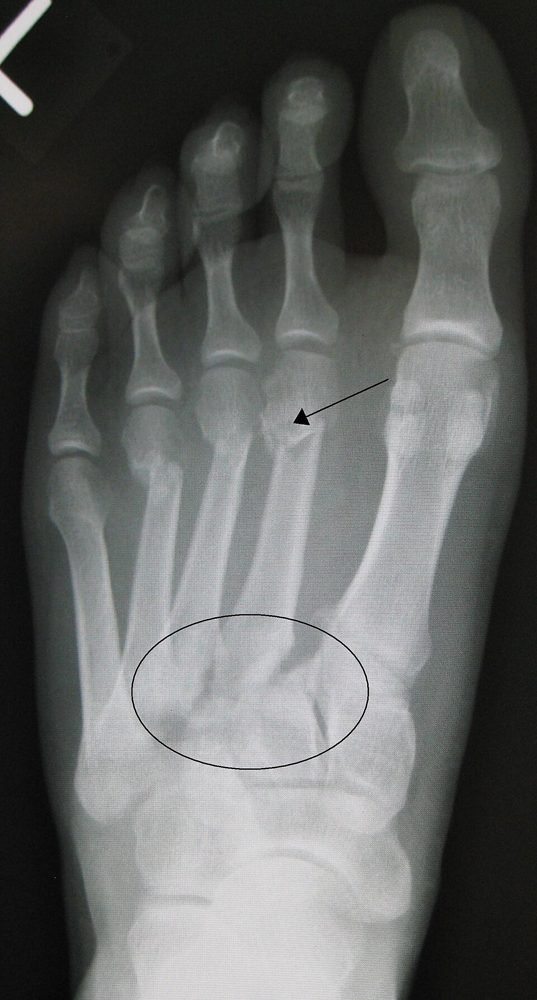
- March fracture: early films are normal in most; periosteal callus appears after 2–3 weeks. MRI (bone oedema) or bone scan confirms it early.
- Several metatarsal fractures or a fracture of the second metatarsal base: look for a Lisfranc injury.
Classification
- 87.1–87.5
- Metatarsal by number (87.1 first to 87.5 fifth).
- .1 / .2 / .3
- Proximal end, diaphysis, distal end (neck and head).
- A / B / C
- Shaft: simple, wedge, multifragmentary. Ends: extra-articular, partial articular, complete articular.
- Stress fracture
- Usually 87.2–87.3 distal shaft or neck; fifth metatarsal proximal shaft stress fractures behave differently (see Jones).
Types shown in 3D
- Second metatarsal shaft
- Simple transverse or short oblique shaft fracture (87.2.2A): the distal fragment tips plantarwards and shortens slightly. Treated in a stiff shoe unless sagittal angulation exceeds about 10° or translation 3–4 mm.
- Multiple shafts (2nd–4th)
- Crush injury breaking several neighbouring shafts: the transverse arch loses its support and the heads drop. More often fixed (K-wires or plates); watch the skin and compartments.
- Neck (3rd)
- Metatarsal neck fracture (87.3.3A): the head displaces plantarwards and proximally and can become a painful prominence under the forefoot. Reduce and pin if clearly displaced.
- First metatarsal shaft
- 87.1.2: the first ray carries about a third of the forefoot load and controls the sesamoids, so displacement, shortening or rotation are not accepted: plate or screw fixation.
- March (stress) fracture
- Fatigue fracture of the distal shaft or neck of the second (or third) metatarsal after unaccustomed walking or running. The line is a hairline; callus appears at 2–3 weeks. Rest in a stiff shoe and treat the cause.
Treatment
- Central metatarsals (2nd–4th), acceptable alignment
- Most are treated without surgery: stiff-soled shoe or walking boot, weight bearing as tolerated, 4–6 weeks. Accept rotation and mild shortening.
- Central metatarsals, displaced
- Fix when the sagittal angulation exceeds about 10° or the translation 3–4 mm, especially with several adjacent fractures (the transverse arch collapses): closed or open reduction and antegrade or retrograde K-wires, or small plates.
- First metatarsal
- Undisplaced: cast or boot. Any displacement, shortening or articular step: ORIF with a plate or screws, because the first ray carries much of the load and controls the sesamoids.
- March (stress) fracture
- Rest from the provoking activity, stiff shoe or boot with weight bearing as tolerated for 4–6 weeks, then a graded return. Treat the cause: training errors, footwear, vitamin D and bone health, energy availability.
Aftercare
Weight bearing as symptoms allow in most; after fixation, heel weight bearing in a postoperative shoe for 6 weeks. K-wires out at 4–6 weeks.
Complications
- Plantar malunion: transfer metatarsalgia and callosities
- Dorsal malunion: transfer lesions under adjacent heads
- Non-union (rare in central shafts)
- Compartment syndrome after crush
- Recurrence of stress fractures if the cause is not addressed
See it in 3D on the real bones, displace and reduce it, with simulated X-ray and CT — free, in your browser.
Open in 3D →