 OpenDissect
All fractures › Shoulder & arm
Supracondylar humerus fracture (child)
AO PCCF 13-M/3Paediatric, extension type
See it in 3D on the real bones, displace and reduce it, with simulated X-ray and CT — free, in your browser.
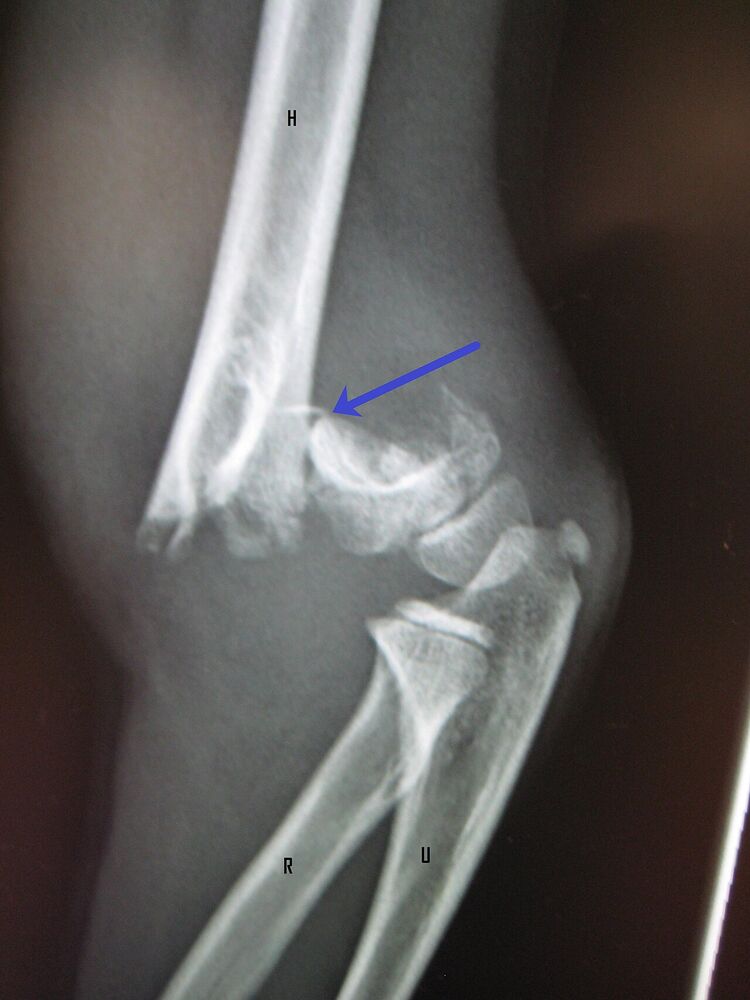
Open in 3D →The commonest elbow fracture in children (age 5–7). The thin bone between the olecranon and coronoid fossae breaks; in the extension type the distal fragment displaces posteriorly and the proximal spike can injure the brachial artery and the median nerve.
Mechanism
Fall on the outstretched hand with the elbow hyperextended (extension type, 95%).
Clinical findings
- Check the hand: perfused and pink vs white; radial pulse; anterior interosseous nerve ("OK" sign) most often injured, then radial and ulnar nerves.
- Pucker sign: the proximal fragment has pierced brachialis (difficult reduction).
- Watch for compartment syndrome of the forearm.
Imaging
- AP and true lateral of the elbow.
- On the lateral: anterior humeral line (should cross the middle third of the capitellum), posterior fat pad sign in occult fractures.
- Comparison views of the other elbow are rarely needed. Neurovascular status first: radial pulse and AIN (OK sign).
- AP and lateral elbow. Anterior humeral line should pass through the middle third of the capitellum; posterior fat pad sign = occult fracture; Baumann angle on the AP view.
Classification
- Gartland I
- Undisplaced.
- Gartland II
- Displaced with an intact posterior hinge.
- Gartland III
- Completely displaced.
- Gartland IV
- Unstable in flexion and extension (periosteum torn all round).
Types shown in 3D
- Gartland I
- Undisplaced; only a posterior fat pad may show. Above-elbow cast 3 weeks.
- Gartland II
- Angulated with an intact posterior cortex (hinge): the anterior humeral line misses the capitellum. Closed reduction and pinning if the angulation is unacceptable.
- Gartland III
- Completely displaced, usually posteromedially; the proximal spike threatens the brachial artery and median nerve. Urgent closed reduction and K-wires.
Treatment
- Gartland I
- Above-elbow cast at 90° for 3 weeks.
- Gartland II–IV
- Closed reduction and percutaneous K-wire fixation (two or three lateral wires, or crossed wires with a small medial incision to protect the ulnar nerve). Pink pulseless hand: urgent reduction, then reassess. White pulseless hand: emergency reduction and vascular exploration if not perfused.
Aftercare
Wires removed at 3–4 weeks.
Complications
- Cubitus varus (gunstock deformity)
- Volkmann ischaemic contracture
- Nerve palsies (mostly recover)
See it in 3D on the real bones, displace and reduce it, with simulated X-ray and CT — free, in your browser.
Open in 3D →