 OpenDissect
All fractures › Hip & femur
Periprosthetic femoral fracture (hip stem)
Vancouver / UCS IV.3A, B1–B3, C · around a hip stem
See it in 3D on the real bones, displace and reduce it, with simulated X-ray and CT — free, in your browser.
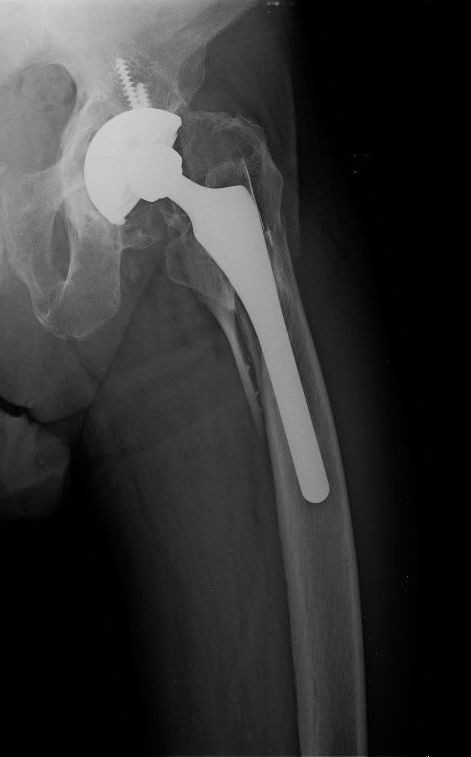
Open in 3D →A fracture of the femur around or below a hip replacement stem. Its incidence rises with every arthroplasty done in an ageing population. The Vancouver classification combines three questions: where is the fracture (trochanters, around the stem, well below it), is the stem still well fixed, and is the bone stock good enough to hold a new implant. Stem stability is the key question, because a loose stem must be revised, not plated. (The model here shows the native femur only; the text describes the stem.)
Mechanism
Mostly low-energy falls in elderly patients. Risk factors: osteoporosis, uncemented stems (especially early) and, among cemented stems, polished taper-slip designs, a loose or osteolytic stem, revision surgery, female sex, rheumatoid arthritis. Intraoperative fractures occur while broaching or impacting a press-fit stem.
Clinical findings
- Pain, deformity and inability to bear weight after a fall in a patient with a hip replacement.
- Ask about pain before the fall (start-up thigh pain suggests a loose stem) and prior infection; check the operation note for the implant type.
- Infection must be excluded: CRP, and aspiration if suspected. Many patients are frail: orthogeriatric care from the start.
Imaging
- AP pelvis and AP and lateral of the whole femur including the knee.
- Compare with previous post-operative films: stem subsidence, cement mantle fracture, radiolucent lines or osteolysis suggest a loose stem.
- CT (with metal artefact reduction) for stem fixation and bone stock when unclear; infection markers (CRP) and aspiration if suspected.
- AP pelvis and AP and lateral of the whole femur including the knee (a knee replacement below changes the plan).
- Compare with previous films: subsidence of the stem, a cement mantle fracture, a radiolucent line around the stem or osteolysis all suggest a loose stem (B2).
- CT helps judge stem fixation and bone stock; the final decision on stability is often made in theatre (test the stem under direct vision).
Classification
- Vancouver A_G
- Greater trochanter fracture (often osteolysis behind it).
- Vancouver A_L
- Lesser trochanter fracture: check that the calcar and stem fixation are intact.
- Vancouver B1
- Around or just below the stem, stem well fixed.
- Vancouver B2
- Around the stem, stem loose, good bone stock.
- Vancouver B3
- Around the stem, stem loose, poor bone stock or severe comminution.
- Vancouver C
- Well below the stem tip: treat as a femoral fracture independent of the implant.
- UCS (Unified Classification)
- Extends Vancouver to every joint: adds D (fracture between two implants, e.g. hip and knee), E (fractures of two bones supporting one implant) and F (fracture of the bone articulating with a hemiarthroplasty).
Types shown in 3D
- Vancouver A_G
- Greater trochanter: often through an area of osteolysis. Abductors pull the fragment up. Fix if displaced more than about 2 cm or if the hip is unstable.
- Vancouver A_L
- Lesser trochanter pulled off by iliopsoas. Usually harmless, but a large fragment can take the medial calcar with it and loosen the stem.
- Vancouver B1
- Spiral or oblique fracture around the stem, which is still well fixed (no subsidence, intact cement mantle or bone ingrowth). Treat with a long locking plate and cables spanning the stem.
- Vancouver B2
- Same level, but the stem is loose (it has subsided or the fracture runs through the cement mantle / proximal bone that held it). Revise to a long distally fixed stem that bypasses the fracture.
- Vancouver B3
- Loose stem with poor bone stock: the proximal femur is comminuted or eroded. Long tapered fluted revision stem, proximal femoral replacement or allograft–prosthesis composite.
- Vancouver C
- Well below the stem tip: fix it as a femoral shaft or distal femur fracture, but overlap the stem with the plate so that no unprotected bone is left between implants.
Treatment
- Vancouver A
- Usually non-operative with protected weight bearing and limited abduction. Fix a greater trochanter displaced more than about 2 cm, or one causing abductor weakness or instability (cable-grip or hook plate, cables, tension band).
- Vancouver B1
- Open reduction and internal fixation: a long locking plate spanning the whole femur, with cables and locking screws around the stem, ± allograft strut. Overlap the stem by at least two cortical diameters to avoid a stress riser.
- Vancouver B2
- Revise the stem to a long, distally fixed implant (modular fluted tapered or extensively coated) that bypasses the fracture by at least two cortical diameters, plus cerclage of the proximal fragments. In selected cemented polished taper-slip stems with an intact bone–cement interface, reduction and fixation with cement-in-cement revision is an option.
- Vancouver B3
- Revision with a long tapered fluted stem if there is enough distal diaphysis to grip; otherwise proximal femoral replacement (megaprosthesis) or an allograft–prosthesis composite. Choose dual-mobility or a constrained liner to lower the dislocation risk.
- Vancouver C
- Locking plate that overlaps the stem (and any knee implant), to avoid an unprotected segment of bone between two implants; a retrograde nail leaves a gap below the stem and is usually combined with a plate.
Aftercare
Early mobilisation is the goal; weight bearing depends on the construct (often immediate after revision with a distally fixed stem, protected after plating). Thromboprophylaxis, osteoporosis treatment and a fall assessment.
Complications
- High 1-year mortality (similar to a hip fracture)
- Non-union and plate failure (often from missing a loose stem)
- Dislocation after revision
- Infection
- Refracture at the end of a plate or between implants
See it in 3D on the real bones, displace and reduce it, with simulated X-ray and CT — free, in your browser.
Open in 3D →