 OpenDissect
All fractures › Hand
Thumb metacarpal base fractures
AO/OTA 77.1.1Bennett, Rolando, extra-articular
See it in 3D on the real bones, displace and reduce it, with simulated X-ray and CT — free, in your browser.
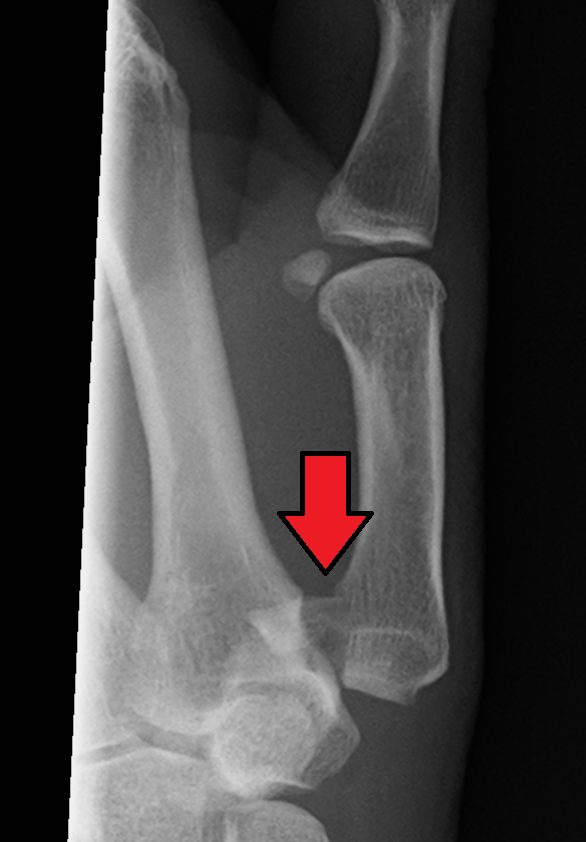
Open in 3D →The base of the thumb metacarpal forms the saddle-shaped trapeziometacarpal joint. In a Bennett fracture a small volar-ulnar fragment stays tied to the trapezium by the anterior oblique (beak) ligament, while the abductor pollicis longus pulls the rest of the metacarpal proximally and radially and the adductor pollicis swings its head into the palm. The joint is subluxed and does not stay reduced in a cast.
Mechanism
Axial load on the partly flexed thumb: punching, falls, ball sports, handlebar injuries.
Clinical findings
- Swelling and tenderness at the base of the thumb; painful pinch and grip.
- The thumb looks short and adducted with a prominence at its base (displaced Bennett).
- Exclude the neighbouring injuries that look similar: scaphoid and trapezium fractures (proximal) and ulnar collateral ligament (skier’s thumb) injury (distal).
Imaging
- True AP of the thumb (Robert view: forearm fully pronated, dorsum of the thumb on the cassette).
- True lateral of the thumb (hand pronated about 20°, thumb flat on the cassette).
- CT for Rolando fractures and to plan fixation.
- True AP of the thumb (Robert view, hand hyperpronated) and true lateral of the thumb; standard hand views are oblique to the thumb and underestimate the step.
- CT for comminuted (Rolando) fractures and to measure the articular step before surgery.
Classification
- 77.1.1A
- Extra-articular base fractures: transverse or oblique, typically with apex dorsal-radial angulation.
- 77.1.1B (Bennett)
- Partial articular: a single volar-ulnar fragment with subluxation of the metacarpal shaft.
- 77.1.1C (Rolando)
- Complete articular: Y- or T-shaped or comminuted base.
- Gedda (Bennett)
- I large fragment with subluxation, II impaction without subluxation, III small avulsion with dislocation.
Types shown in 3D
- Bennett (77.1.1B)
- A single volar-ulnar fragment stays with the trapezium (anterior oblique ligament); the shaft subluxes proximally and radially (abductor pollicis longus) and adducts (adductor pollicis). Unstable: K-wires or a lag screw.
- Rolando (77.1.1C)
- Complete articular Y- or T-shaped fracture: volar and dorsal base fragments split apart and the shaft is driven in between. Plate for large fragments, traction or external fixation for comminution.
- Extra-articular (77.1.1A)
- Transverse or short oblique fracture just distal to the joint; the distal fragment is flexed and adducted (apex dorsal-radial). The CMC joint compensates up to about 20–30° of angulation: cast; more needs reduction and K-wires.
Treatment
- Extra-articular
- Up to about 20–30° of angulation is compensated by the very mobile CMC joint: thumb spica cast for 4–6 weeks. More angulation, or instability: closed reduction and K-wires.
- Bennett
- Reduce by traction, abduction and pronation of the thumb with pressure on the base. Hold with percutaneous K-wires (metacarpal to trapezium or to the index metacarpal) or, for a large fragment, open reduction and one or two lag screws. Aim for an articular step < 1–2 mm.
- Rolando
- Large fragments: open reduction and a small T- or L-plate. Severe comminution: traction (external fixator or K-wire distraction) to restore length and let the joint mould.
Aftercare
Thumb spica splint for about 4–6 weeks; K-wires out at 4–6 weeks, then pinch strengthening.
Complications
- Trapeziometacarpal arthritis (higher with residual step and comminution)
- Loss of reduction in a cast
- Adduction contracture of the first web space
- Pin-site infection, irritation of the superficial radial nerve
See it in 3D on the real bones, displace and reduce it, with simulated X-ray and CT — free, in your browser.
Open in 3D →