 OpenDissect
All fractures › Elbow, forearm & wrist
Distal radius fracture
AO/OTA 2R3A2Extra-articular, dorsally tilted (Colles)
See it in 3D on the real bones, displace and reduce it, with simulated X-ray and CT — free, in your browser.
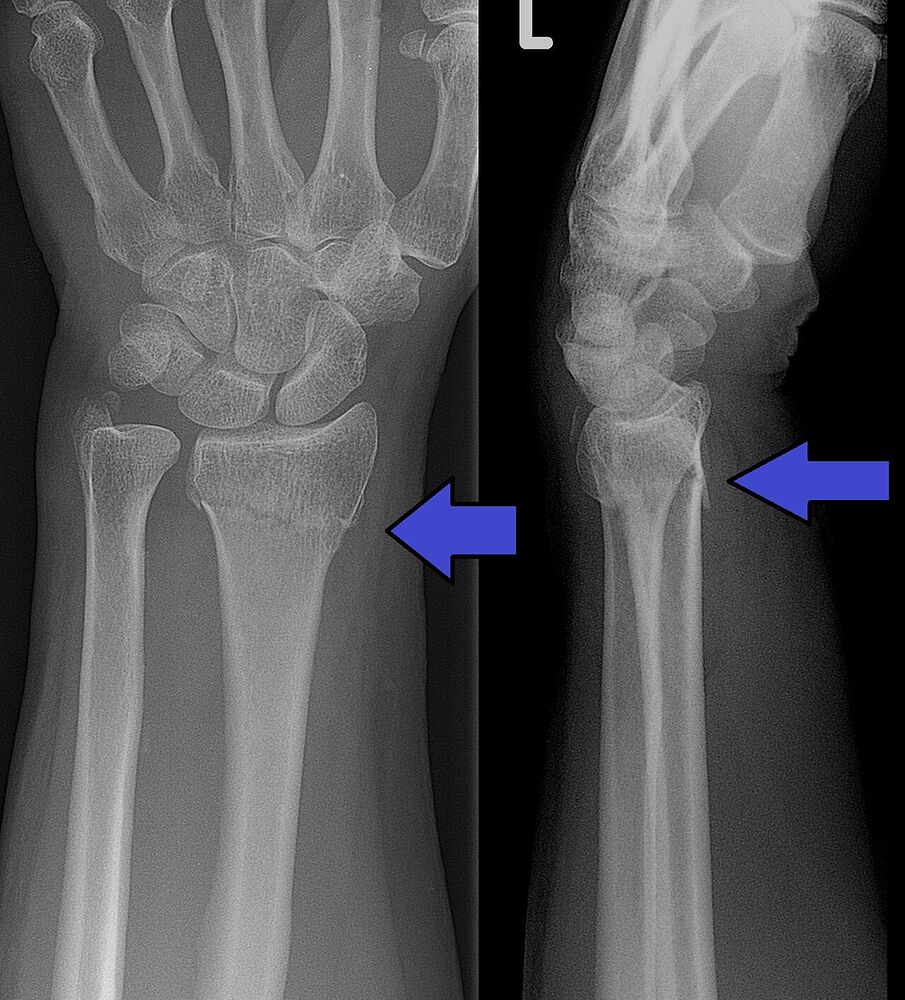
Open in 3D →The most common fracture in adults. In a Colles fracture the distal fragment tilts and shifts dorsally and the radius shortens, giving the "dinner fork" deformity. Normal values: radial inclination about 22°, volar tilt about 11°, radial height about 11 mm, ulnar variance neutral.
Mechanism
Fall on the outstretched hand with the wrist extended (Colles, dorsal). Fall on the flexed wrist gives a Smith fracture (volar displacement).
Clinical findings
- Dinner-fork deformity, swelling; check the median nerve (acute carpal tunnel syndrome) and the skin.
- Look for associated scaphoid fracture and ulnar styloid fracture.
Imaging
- PA and lateral of the wrist.
- Measure radial inclination (~22°), radial height (~11 mm), volar tilt (~11°) and ulnar variance.
- CT for intra-articular fractures (die-punch, volar rim) before surgery. Check the median nerve.
- PA and lateral views; measure radial inclination, height, volar tilt, articular step and ulnar variance. CT for complex articular fractures.
Classification
- 2R3A
- Extra-articular (A2 simple, A3 wedge/multifragmentary).
- 2R3B
- Partial articular: radial styloid (chauffeur), volar Barton (B3), dorsal Barton (B2).
- 2R3C
- Complete articular.
- Eponyms
- Colles (dorsal displacement), Smith (volar), Barton (rim fracture with carpal subluxation), chauffeur (radial styloid).
Types shown in 3D
- Colles (2R3A2)
- Extra-articular, dorsal tilt and dorsal shift with radial shortening: "dinner fork".
- Smith (2R3A2)
- Extra-articular with volar tilt and volar displacement ("reverse Colles"): unstable in a cast, usually plated.
- Chauffeur (2R3B1)
- Radial styloid: partial articular; often part of a perilunate injury, so check the carpus. Screws or K-wires.
- Dorsal Barton (2R3B2)
- Dorsal rim fracture with the carpus subluxed dorsally.
- Volar Barton (2R3B3)
- Volar rim shear fracture with the carpus subluxed volarly: unstable, needs a volar buttress plate.
- 2R3C1
- Complete articular, simple: the radial styloid and the lunate facet are split from each other and from the shaft. CT and anatomical reduction of the joint.
Treatment
- Non-operative
- Closed reduction under haematoma block and a well-moulded dorsal or sugar-tong splint, then cast for about 5–6 weeks. Acceptable after reduction (adults): dorsal tilt < 10°, radial shortening < 3 mm, articular step < 2 mm; more tolerance in elderly low-demand patients.
- Operative
- Unstable or unacceptable reduction, articular displacement, volar shear (Smith/Barton), open fractures: volar locking plate through the FCR (modified Henry) approach is the workhorse; K-wires, external fixation or dorsal / fragment-specific plates in selected cases.
Aftercare
Early finger motion; wrist motion after 1–2 weeks with stable plating.
Complications
- Malunion (loss of tilt and height)
- Median nerve compression, CRPS
- EPL tendon rupture (also after undisplaced fractures)
- Flexor tendon irritation by a plate placed beyond the watershed line
See it in 3D on the real bones, displace and reduce it, with simulated X-ray and CT — free, in your browser.
Open in 3D →